
Sport
Bayern Munich’s History: The Journey of Building a Football Empire
When it comes to German football, it is difficult to find a name with greater influence than Bayern Munich. From a team founded in a café in Munich, Bayern gradually built its reputation to become a symbol of the Bundesliga and one of the most successful clubs in European football.
The history of Bayern Munich is not simply a story about trophies. It is also the journey of generations of players, coaches, and executives who have shaped the club’s distinctive identity. When watching Bayern play on Xoilac, fans can clearly appreciate the hallmark of a team that has always prioritized winning and consistency.
The Origins and Founding of Bayern Munich
On February 27, 1900, a group of young players led by Franz John founded FC Bayern at Café Gisela in Munich. This marked the beginning of the Bavarian club’s journey, which has now spanned more than a century.
In its early years, Bayern had to compete with numerous local teams and experienced changes involving its grounds, organization, and finances. However, the club quickly developed, winning the South German Championship in 1926 before claiming its first German national championship in 1932.
That first title laid the foundation for greater ambitions. From a local club, Bayern began striving to become the number one team in Germany.
A Difficult Period and the Process of Rebuilding
After winning the championship in 1932, Bayern entered a period of considerable upheaval. Political, social, and football-related challenges in Germany meant that the club’s development did not proceed continuously.
It was not until the 1960s that Bayern truly made a breakthrough. The establishment of the Bundesliga in 1963 opened up a new competitive arena, and Bayern gradually assembled a squad capable of competing at the highest level.
In 1966, Bayern won their first German Cup. Just one year later, the club made its mark in Europe by winning the European Cup Winners' Cup. These achievements signaled that a golden era was approaching.
Fans following Xoilac 365 today can see that Bayern’s playing style is very different from that of the club in its early days, yet its fiercely competitive spirit has remained intact.
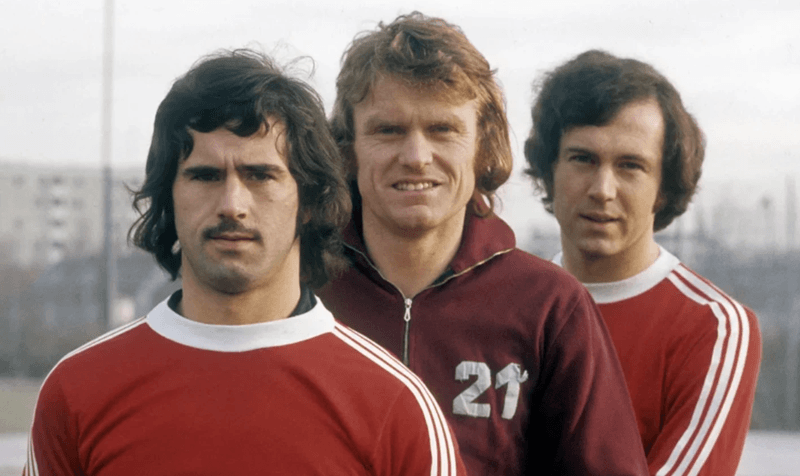 The Beckenbauer generation took Bayern to the summit of European football.
The Years of Bayern Munich’s Dominance
If one period had to be chosen as the turning point that completely transformed Bayern’s status, it would undoubtedly be the 1970s.
With stars such as Franz Beckenbauer, Gerd Müller, Sepp Maier, Paul Breitner, and Uli Hoeneß, Bayern became a dominant force in both German and European football.
In 1974, Bayern won the European Cup for the first time after defeating Atlético Madrid in a replay of the final. This was the first European championship in the club’s history.
Over the following two years, Bayern successfully defended their title. The team defeated Leeds United in 1975 and Saint-Étienne in 1976, completing a hat-trick of consecutive European Cup titles.
This was the period when Bayern evolved from German champions into a truly formidable name in European football.
Bayern Munich and the Historic Treble in 2013
One of the finest chapters in the history of Bayern Munich came during the 2012/13 season.
After suffering a painful defeat to Chelsea in the 2012 Champions League final, Bayern returned as a stronger team under Jupp Heynckes.
The club won the Bundesliga by a substantial margin before defeating Borussia Dortmund in the first all-German Champions League final. Bayern then beat Stuttgart in the DFB-Pokal final to complete a historic treble.
Players such as Philipp Lahm, Bastian Schweinsteiger, Franck Ribéry, Arjen Robben, and Thomas Müller became symbols of a highly competitive Bayern generation.
It is no surprise that every match played by the team during this period attracted considerable attention on Xoilac Tivi.
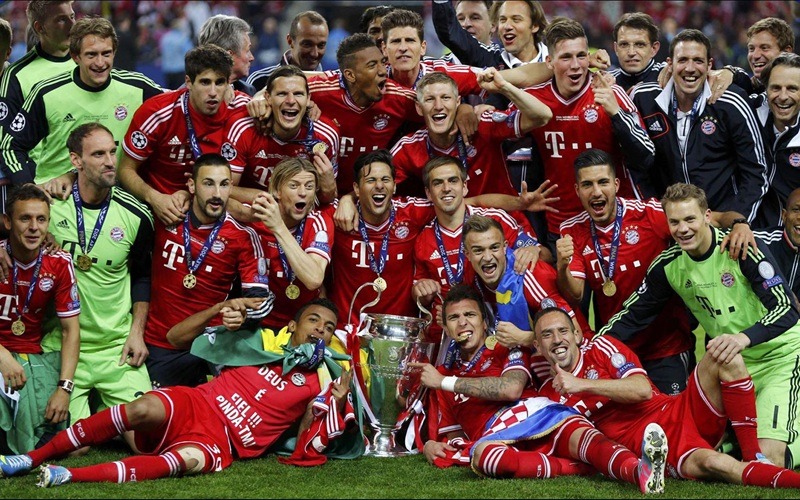 Bayern Munich completed a historic treble in the 2012/13 season.
The Sextuple and the Peak of 2020
If 2013 was the season of the treble, 2020 took Bayern to an even higher level.
Under the leadership of Hansi Flick, Bayern won the Bundesliga, DFB-Pokal, and Champions League. In the Champions League final, the team defeated Paris Saint-Germain 1–0 thanks to a goal from Kingsley Coman.
Bayern subsequently won the UEFA Super Cup, German Super Cup, and FIFA Club World Cup, completing a remarkable collection of six trophies during this exceptional period.
UEFA records Bayern as having won the European Cup/Champions League six times, in 1974, 1975, 1976, 2001, 2013, and 2020.
The Icons Who Shaped Bayern Munich
Bayern’s history has been written by many generations of legendary players.
Franz Beckenbauer represented elegance and leadership. Gerd Müller is remembered as a prolific goal scorer with an exceptional instinct for finishing inside the penalty area. Karl-Heinz Rummenigge became a symbol of the 1980s, while Oliver Kahn embodied a formidable fighting spirit.
As the 21st century progressed, Bayern continued to feature renowned names such as Philipp Lahm, Bastian Schweinsteiger, Thomas Müller, Manuel Neuer, Arjen Robben, and Franck Ribéry.
Thomas Müller, in particular, became one of the players most closely associated with the club over an extended period. These individual achievements have helped Bayern preserve its identity despite frequent changes to the squad.
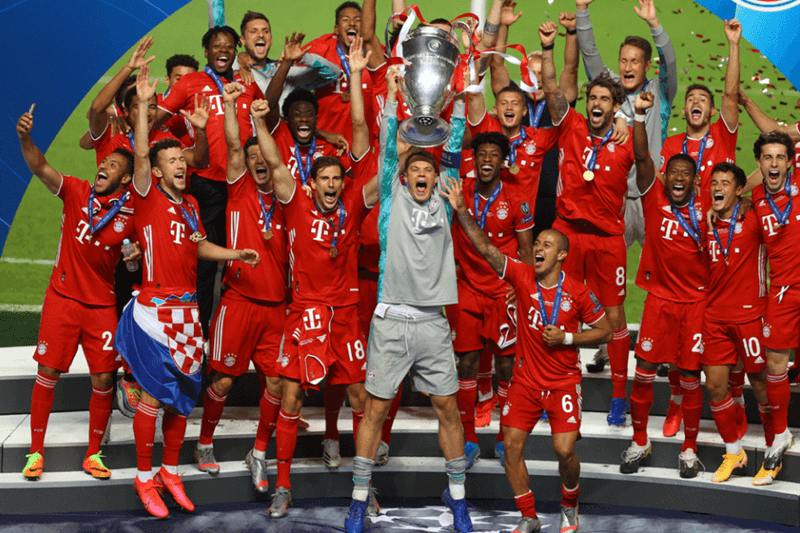 Bayern Munich and the journey to six European Cup/Champions League titles.
Achievements Befitting the Status of the Bavarian Giants
According to the club’s official statistics, Bayern have won 35 German national league titles, along with 20 German Cups and six Champions League/European Cup titles. The team has also won the UEFA Cup, UEFA Cup Winners' Cup, FIFA Club World Cup, and numerous other international competitions.
These figures explain why Bayern are regarded as Germany’s leading football club throughout much of Bundesliga history.
Whenever fans check kết quả bóng đá hey are interested not only in whether Bayern have won or lost but also in where the team stands in its ongoing effort to maintain its status.
Bayern Munich Today and a Legacy Spanning More Than a Century
From Café Gisela in 1900 to the modern Allianz Arena, Bayern have experienced a journey filled with dramatic changes. The club has endured difficult periods and bitter defeats, but it has also repeatedly returned to the top to claim major honors.
That is the greatest value of the history of Bayern Munich: the ability to rebuild its strength with every new generation.
For fans, following XoilacTV is about more than watching a football match. It is also an opportunity to witness a piece of history continuing to unfold on the pitch, from emerging stars to records that have never been achieved before.
Conclusion
The history of Bayern Munich is a story of ambition, resilience, and an exceptional ability to sustain success. From the first German championship in 1932 and the European Cup hat-trick of the 1970s to the Champions League title in 2001, the treble in 2013, and the sextuple in 2020, Bayern have consistently created memorable milestones.
More than 120 years after its founding, the Bavarian giant remains a major force in European football. And as Xoilac Live continues to bring fans exciting matches, supporters have more opportunities to witness the next chapter in the journey of one of the greatest clubs in football history.